The hold, explained
What you can bring on a private jet
Charter luggage has no weight bands, no fees per bag, no oversize counter — but it has physics: a hold is a fixed space, and what fits, flies. This guide translates physics into packing decisions: capacities by class, the pet rules, sports gear, and the short list of things that genuinely can't board.
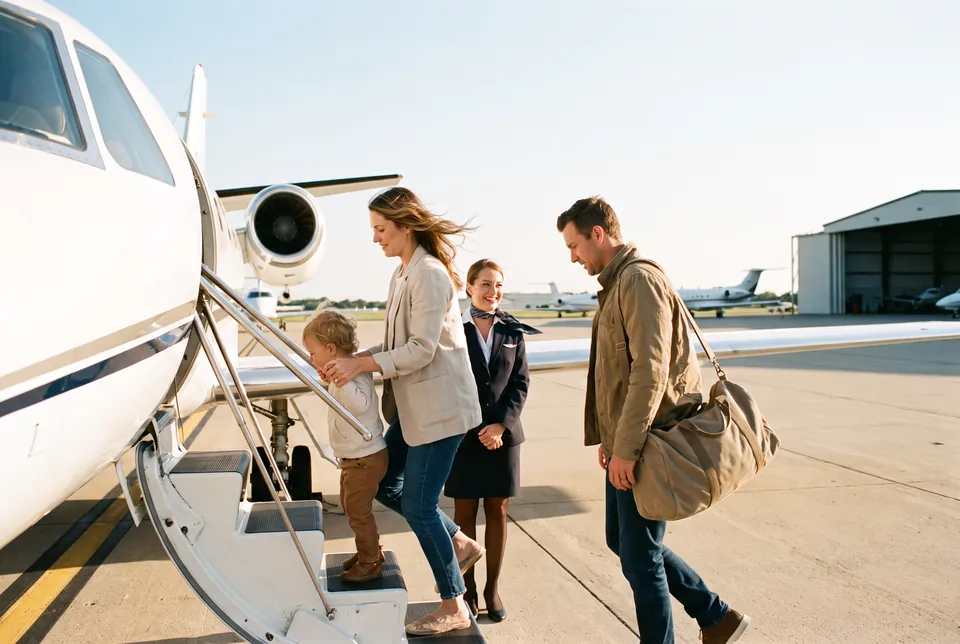
The one rule: volume, not weight
Airlines ration kilograms; charter rations litres. An aircraft's hold is a shaped compartment — long and shallow on light jets, walk-adjacent lockers on bigger metal — and the packing question is geometric: does the shape of your luggage fit the shape of the space? This is why soft bags are charter's native format: they deform to the hold's curves, stack without air gaps, and effectively enlarge the compartment by a third against rigid cases.
It's also why the single most useful sentence in your booking brief is a luggage manifest: 'six soft duffels, two ski bags, one hard camera case, a stroller'. The desk converts that to volume instantly, and the aircraft that arrives is one where everything fits — the alternative being the ramp-side Tetris nobody enjoys. The booking guide puts this in the first message for a reason.
What actually fits, class by class
| Class | Realistic capacity | Sports gear | Watch out for |
|---|---|---|---|
| Turboprop | 6–8 soft bags | Skis, dive kit, golf — surprisingly good | Cabin-accessible holds on PC-12s swallow odd shapes |
| Light jet | 4–6 soft bags + small items | 2 golf bags or 2–3 ski bags in sleeves | Rigid trunks; full cabins leave thin margins |
| Midsize | 8–10 bags incl. some rigid | Family ski kit, 4 golf bags | The class where luggage stops being the constraint |
| Super-mid | 10–12 bags, mixed formats | Group kit, production gear | Long items: confirm hold door dimensions |
| Heavy | 14+ bags, wardrobe cargo | Everything above, doubled | In-flight access to some holds, not all |
| ULR | Trip-scale cargo | Tour and expedition loads | Almost nothing, within reason |
Capacities summarised from manufacturer hold specifications and operator guidance, 2025.
Pets: the real rules behind 'yes'
The headline is accurate — pets fly in the cabin, at the operator's discretion, and most operators' discretion is yes. No cargo hold, no sedation debates, no airline crate theatre: your dog lies at your feet from London to Nice. The practical layer: say the species, size and count in the brief (some tails have owner-imposed no-pet policies; the desk filters), expect a cleaning fee for shedding breeds, and bring a familiar blanket — cabins are leather-rich environments.
The destination is the real regulator. Rabies-free islands and strict-quarantine states (the UK's pet travel scheme, island Asia's permits, Maldives paperwork) apply regardless of how you arrive, and some need weeks of lead time. The desk checks the destination's current rules the moment your brief mentions a pet — mention it even for the 'just asking' stage.
Three real manifests, three right answers
Theory lands better as cases. Ski family of five, London–Geneva February: five soft duffels, four ski bags, two boot bags, a stroller. Light-jet holds technically close around it; the midsize takes it without negotiation — and the quote delta, split five ways, costs less than one day's lift passes. Golf four, Singapore–Phuket: four soft bags, four golf sets. A light jet handles it cleanly because golf bags stack where rigid cases won't — the classic case where soft-sided discipline saves a class upgrade. Wedding advance party, Bogotá–Cartagena: three passengers, six garment bags, two Peli cases of photography kit, a dress that travels on its own seat. Midsize, dress strapped in beside the maid of honour, cases counted in the brief.
Three different aircraft answers from three luggage lists — and in each case the list, sent before quoting, is what made the answer right first time. The manifest message costs thirty seconds; the ramp-side discovery costs the morning.
Sports gear, instruments, production kit
Skis and golf travel in soft sleeves in any jet hold from light upward — the Geneva corridor runs on exactly this cargo all winter. Bikes want boxes and a midsize-plus hold, or soft cases on a light jet with lean passenger loads. Instruments: anything cello-sized flies strapped into a cabin seat (buy no ticket, occupy one seat — say it in the brief); violins ride laps; a double bass wants midsize-plus. Camera and production gear: Peli cases are rigid-case territory — count them precisely in the brief, and for serious shoots ask about a dedicated kit aircraft; it's cheaper than it sounds and saves the A-team's hold space.
The pattern: unusual cargo is normal in charter. What breaks trips isn't the cello — it's the cello nobody mentioned until the ramp.
The short list of true limits
Charter is permissive, not lawless. Dangerous goods rules still apply: no loose lithium battery crates, flammables, fireworks — the aviation-wide list. Firearms fly legally with the right paperwork (unloaded, cased, declared, destination-legal) and operators handle hunting-trip logistics routinely — but the paperwork is real and the brief needs it early. Cash and valuables: no airline-style limits, but customs declaration thresholds (US$10,000-equivalents) exist at borders exactly as they do downstairs. Alcohol: yours is welcome aboard; destination import limits are yours to respect. When in doubt, the question costs one message — the answer 'no' is rare enough to be memorable.
Packing for charter: the counterintuitive habits
Three habits distinguish experienced charter packers. Soft multiplies: two duffels beat one rigid case of equal litres, every time. Keep-with-you kit: passports, medication, chargers in a small cabin bag — holds on some types aren't flight-accessible. The return margin: shopping expands luggage; a trip that departs at hold capacity returns over it. The Milan corridor's fashion traffic solved this generations ago — garment bags on seats, samples in soft trunks, and a manifest message before each direction. Steal the method.
Questions about this flight
Is there a baggage allowance on a private jet?
No fee-per-bag system — the limit is the hold's physical volume, summarised by class in the table above. List your luggage in the booking brief and the aircraft offered will be one it fits in. That's the entire system.
Can my dog really sit with me in the cabin?
On most aircraft, yes — operator's discretion, cabin not cargo, usually with a cleaning fee. The binding rules belong to your destination (quarantine and permit regimes), which the desk checks when your brief mentions the pet. Lead time matters for strict destinations.
Do skis and golf clubs cost extra?
Can I bring liquids, my own wine, duty-free?
Freely — no 100ml theatre at FBOs. Your wine is welcome in the cabin (tell the crew and it's chilled for descent); destination import allowances still apply at the border like any arrival.
What genuinely cannot fly?
Aviation-wide dangerous goods: flammables, fireworks, bulk loose lithium batteries. Firearms fly with proper declaration and destination legality — paperwork the operator arranges given lead time. The 'no' list is short; the 'mention it first' list is everything unusual.
What about wheelchairs, strollers, medical equipment?
All routine: mobility equipment travels free and the FBO handles ramp assistance gracefully — flag stair limitations and the desk selects aircraft with appropriate door and seating geometry. Medical oxygen and powered equipment need operator sign-off: one message, standard process.
Nearby routes and guides
How to book
Booking a private jet step by step: the first message, comparing quotes, contracts and payment, flight day at the FBO. No experience assumed.
Aircraft
Turboprop to ultra-long-range: what each aircraft class costs per hour, how far it flies, who it suits — with honest published rates.
FAQ
Costs, booking windows, luggage, pets, safety paperwork and empty legs: the questions every first-time charter client asks, answered plainly.